
Okeechobee Busted Arrest Path
Okeechobee city holds the county seat. It is also the area's only incorporated municipality. The Census Bureau put its population near 5,811 in a July 2025 estimate, up from 5,254 in the 2020 count. Small place, but the paperwork is split. OPD handles policing inside the city limits. OCSO runs sheriff duties countywide. It also operates the Okeechobee County Jail, where adult bookings land. Troopers from the Highway Patrol or officers from Fish and Wildlife can also arrest someone. That person still ends up booked at the same jail.
So the arresting agency may not hold the booking file. An OPD report gives the city officers' account of what happened. The OCSO booking record shows when a person entered county custody. It may include a booking photograph. The jail address alone tells you little about where the incident occurred. Before tying a county booking to the city, read the arresting-agency field, the affidavit, or the police report.
Note: Case outcomes can shift after booking, so confirm final results through the Okeechobee Clerk.
The official Okeechobee Police Department page describes how city law enforcement works and where adults in custody get booked.
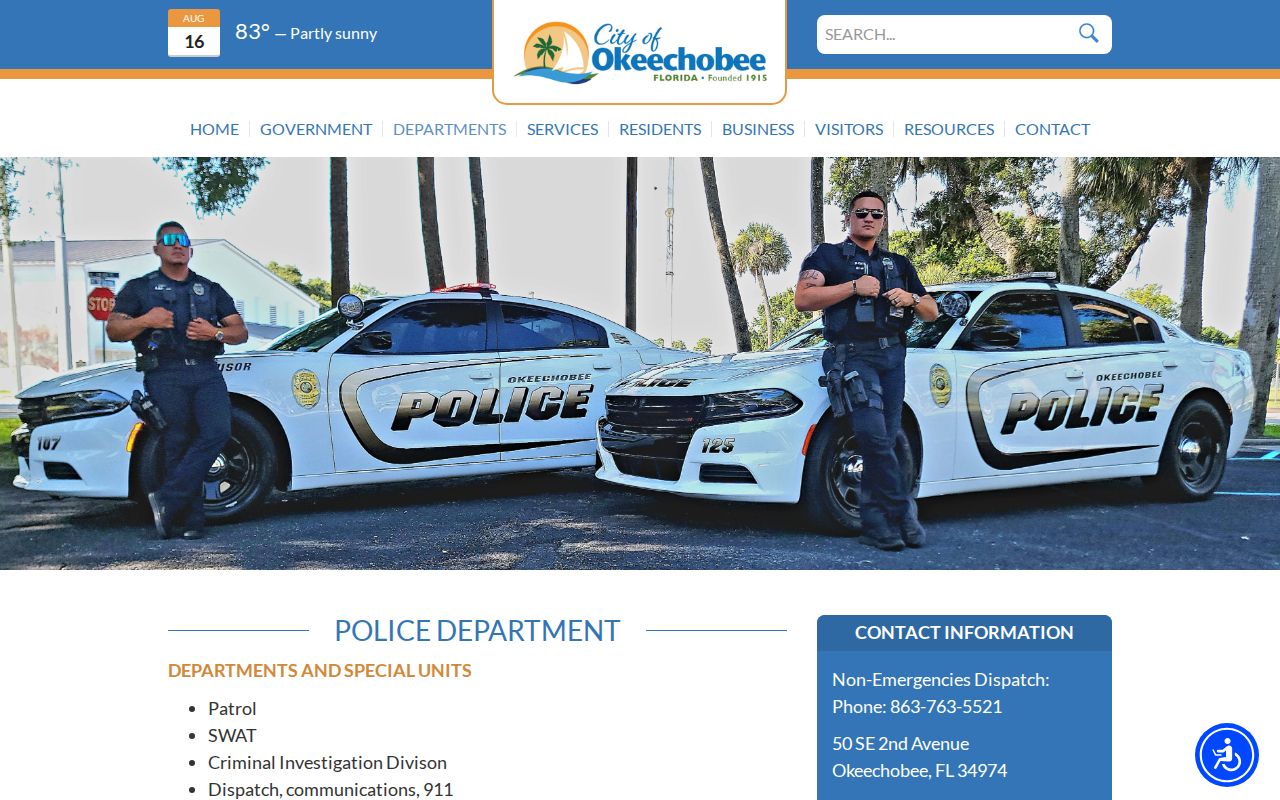
That city page is the cleanest way to tell an OPD arrest apart from the later OCSO jail record.
Where Okeechobee Busted Mugshots Appear
No one source answers every arrest question in Okeechobee. Start with official channels. They name the agency, show current custody, hold the maintained booking record, and carry the court result. News stories and third-party sites can hint at a date or an agency. They cannot confirm someone is still jailed, though, or that a booked charge held up.
| Channel | Photo status | Official? | Best use |
|---|---|---|---|
| OCSO inmate search | Unverified | Yes | Current county-jail custody, if the interface renders |
| OPD Police Records | Not the main jail-photo source | Yes | OPD incident or arrest report |
| OCSO Records | Request a maintained photo | Yes | Booking sheet, release record, and jail intake photo |
| Clerk OCRS | No booking-photo function | Yes | Filed case, charge changes, and disposition |
| Lake Okeechobee News | Not guaranteed | No, local press | Selective weekly felony and DUI reports |
| Busted Newspaper | Often displayed | No | Secondary county orientation only |
| RecentlyBooked | Often displayed | No | Unofficial county-based recent posts |
The Sheriff's inmate-search landing page may fail to load its search controls. When that happens, its fields, photos, update timing, and handling of released entries stay unknown. The problem could be a dynamic page error. The official link is still the first web route to try. If it stalls, call Jail Booking at 863-357-5343. Ask about bond, booked charges, and current status.
Note: A third-party post labeled for the county does not prove an arrest happened inside Okeechobee city limits or that OPD made it.
Who Got Busted in Okeechobee
A solid search follows the record from arrest through court. Take it one source at a time. Each has a narrow job. The OCSO roster tracks present county custody, not people already released. OPD Records holds the city police report. The department is not the main custodian of a county-jail intake photo, though. Someone released from jail may drop off the current roster. The underlying booking record can stay requestable under retention rules and lawful exemptions.
- Confirm that the event concerns Okeechobee city. Match the arresting agency, approximate date, and person with more than a shared name when possible.
- Open the official OCSO inmate-search page for current adult jail custody. If it fails, call Booking for bond, booked charges, and current status.
- Ask OPD Police Records for the city incident or arrest report when OPD handled the event.
- Ask OCSO Records for the existing booking sheet, release record, arrest affidavit, and maintained booking photograph in native electronic form.
- Search the Clerk OCRS docket for filed charges, later changes, disposition, and sentence. The booking card is only the intake snapshot.
The countywide roster, records requests, and feed fallbacks get fuller treatment on the Okeechobee County booking-record hub. Someone later sentenced to Florida state prison or placed under FDC supervision belongs in the Florida Department of Corrections Offender Search instead. That system is not a substitute for a fresh county booking lookup.
OPD and OCSO Arrest Records
The two-custodian split is the local rule that matters most here. Police Records keeps reports written by city officers. OCSO Corrections builds the adult jail intake record once a person reaches the county facility. Ask OPD for everything and you may miss the jail image. Ask OCSO for the city report and you reach the wrong desk. Two narrow, parallel requests serve you better when you need both halves.
- Police report
- The OPD record of the city incident, investigation, and arrest activity.
- Booking record
- The OCSO jail intake record, which may include a booking number, listed charges, bond facts, and a maintained photograph.
- Disposition
- The court’s outcome, such as dismissal, plea, acquittal, adjudication, sentence, or case closure.
Bond amounts can change after first appearance. A name missing from the roster has several possible explanations: the person bonded out, moved to another facility, entered a different custody system, or was booked under an alternate spelling. Pull the Clerk docket to close out the trail.
Request Okeechobee Arrest Records
City Police Records takes requests in person, by phone, by email, or through the city's fillable form. Ask for a specific existing record. Don't ask staff for a new summary. Give the full name, a rough incident or arrest date, and a report number if you have one. The city says it responds as fast as the scope allows. Once it understands the request, it provides an expected date. No fixed turnaround is promised.
Okeechobee Police Records
Police Records Clerk
50 SE 2nd Avenue
Okeechobee, FL 34974
863-763-3372 ext. 9788
PoliceRecords@cityofokeechobee.com
Monday-Friday, 8 a.m.-5 p.m.
Copying costs money. The city posts its rates plainly. A single-sided black-and-white page runs $0.15. Double-sided costs $0.20, while color jumps to $0.50 for one side and $0.75 for two. Certified copies are $1 per page. A listed 4-by-6 photograph costs $6. Requests that take over 15 minutes of staff time may add a reasonable labor or technology charge. Any estimate above $50 needs a deposit up front. One caveat: these are city fees, and they say nothing about the cost of an electronic OCSO booking photo. That part rests with the Sheriff's ledger.
The City of Okeechobee public-records page lays out the request methods, the custodian, and the published fee terms.
That same official page covers the OPD report route. A county-jail intake image, though, lives in a separate system, so request one from OCSO Records on its own track.
No Okeechobee Busted Blotter
There is no official OPD arrest log to browse. The city has no daily bulletin, photo blotter, fixed booking window, or publication schedule. OCSO keeps no separate 24-hour, 48-hour, 72-hour, or weekly booking feed either. The Sheriff's press archive mixes agency news with community posts. Treat it as a general feed, not a complete city arrest log.
Want a defined window? Ask OCSO Records whether a commitment and release list exists for your exact dates. Florida's GS2 schedule describes such a record as potentially holding a booking number, name, charge, court, arresting officer, bond, release method, and related dates. That description does not obligate OCSO to fill every field or build a custom spreadsheet. Availability, review, and redaction all stay with the Sheriff.
Note: A vanished online entry can still exist as a retained, nonexempt underlying record, since web display and agency retention are different things.
Okeechobee Adult Juvenile Arrest Routes
OPD names two destinations outright. Adults arrested in the city land at Okeechobee County Jail. Juvenile offenders go instead to the St. Lucie Regional Juvenile Detention Center in Fort Pierce. That split is operational, not an invitation to hunt for juvenile images, and a name missing from the adult county roster proves nothing about whether a juvenile custody event occurred.
Florida's juvenile-record law runs in shades of gray. Some information tied to felony-equivalent conduct can be public, yet a custodian may still decline to post a juvenile photograph online. No juvenile booking photos are displayed or pursued here. Families who need lawful status information should contact the appropriate agency directly; the juvenile center's published phone is 772-468-3940. Adult status questions still belong with OCSO Booking.
The boundary also guards accuracy. The adult county jail is never the youth destination, and the regional juvenile center is not a source for Okeechobee busted mugshots. Each system plays a different custody role under a different disclosure framework.
Okeechobee Busted News Context
Lake Okeechobee News supplies the steadiest recurring local coverage. Its Wednesday editions have carried selective Okeechobee County Arrest Report columns built around felony and DUI arrests. Those reports credited arrests to OPD, OCSO, FHP, FWC, FDC, and task-force units. They ran as text-led write-ups, not daily booking galleries. Each one offered a correction path.
The Lake Okeechobee News local section is the place to see that selective city and county coverage in context.
Busted Newspaper and RecentlyBooked both maintain active county pages, but neither is official. A Busted Newspaper entry may carry an Okeechobee tag. RecentlyBooked organizes its posts by county. Those labels alone prove nothing about municipal location, live custody, or completeness. Mugshots.com shows only an Okeechobee-titled shell with no visible current cards. Arrests.org returns zero results for the county. Skip the weak shells and lean on official records.
Regional outlets like WOKC, WPTV, and WQCS publish event-driven stories, not full booking feeds. The sound habit is to trace a reported arrest back to the arresting agency, the OCSO booking record, and the Clerk docket. That path separates a news account from what the court actually entered.